
Training for Electron Microscopy of Materials
Training and courses offer in the field of electron microscopy, and additional techniques and applications for advanced materials characterization.
Weibars in electron microscopy applications and additional techniques
Webinar - MicroED in practice : from crystal diffraction to molecular structures
9 octobre 2026, 11h – inscriptions ouvertes
Webinar - Cryo-TEM analysis of organic nanoparticles
Coming soon - this content is currently being prepared
Webinar - Electron Tomography (ET) : Imaging 3D Nanostructure and Chemistry for Advanced Materials
Coming soon - this content is currently being prepared
Webinar – Practical Monte Carlo Simulations for improved electron microscopy
Coming soon - this content is currently being prepared
Webinar - Unlocking 3D microstructure : Non-Destructive Micro-CT Imaging for Advanced Materials
Coming soon - this content is currently being prepared
Your subject suggestion!
There is a subject that you would like to learn more about? Contact us to let us know !
Courses offered in electron microscopy
| Course Title | University | Cycle | Credits |
|---|---|---|---|
| Techniques d’analyse (GML-4103 or GML-7003) Course description | Laval University | Undergrad; Masters; PhDs | 3 credits |
| Microscopie électronique : théorie et pratique (NSC-8002) Course description | Laval University | PhDs | 1 credit |
| Microstructure et propriétés des matériaux (GML-2003) Course description | Laval University | Undergrad | 3 credits |
| Techniques de caractérisation des matériaux (GCH740) Course description | University of Sherbrooke | Masters | 3 credits |
| Techniques de caractérisation des matériaux II (PHY710) Course description | University of Sherbrooke | Masters | 3 credits |
| Introduction aux matériaux (ING301) Course description | University of Sherbrooke | Undergrad | 2 crédits |
| Matériaux fonctionnels (CHM6465) Course description | Deuxième cycle, PhDs | 3 credits | |
| Méthodes en microscopie à haute résolution (BCM6019) Course description | Université de Montréal | Deuxième cycle, PhDs | 1 credit |
| Caractérisation des matériaux en génie de la construction et l’environnement (MGC922) Course description | École de technologie Supérieure | Masters | 3 credits |
| Mise en forme des alliages : expérimentation et simulation (MEC300) Course description | École de technologie Supérieure | Undergrad | 3 credits |
| Caractérisation des matériaux (MTR6040) Course description | Polytechnique Montréal | Deuxième cycle, PhDs | 3 credits |
| Caractérisation minéraologique (GML6604) Course description | Polytechnique Montréal | Deuxième cycle, PhDs | 3 credits |
| Techniques de caractérisation des matériaux I (MET6103A) Course description | Polytechnique Montréal | Deuxième cycle, PhDs | 4 crédits |
| Electron Microscopy and 3D Imaging for Biological Materials(BIEN535) Course description | McGill | 3 credits | |
| Analytical and Characterization Techniques (MIME317) Course description | McGill | 3 credits | |
| Principles and Applications of Materials Characterization (CHEM603) Course description | McGill | 3 credits | |
| Electron Beam Analysis of Materials (MIME569) Course description | McGill | 3 credits | |
| Structure of Materials (MIME261) Course description | McGill | 3 credits |
To signal a missing course, edit or remove courses that have changed, thanks for contacting us
Electron Microscopy Summer School
Every year, the Quebec Network of Electron Microscopy for Materials participates in organizing the summer school to complement the electron microscopy traning offer in Quebec.
Consult a summary of the 2026 microscopy summer school
The 2027 Microscopy Summer School will take place in Sherbrooke. More details will be coming soon.

Documents in electron microscopy
Coming soon - this content is currently being prepared
Coming soon - this content is currently being prepared
Coming soon - this content is currently being prepared
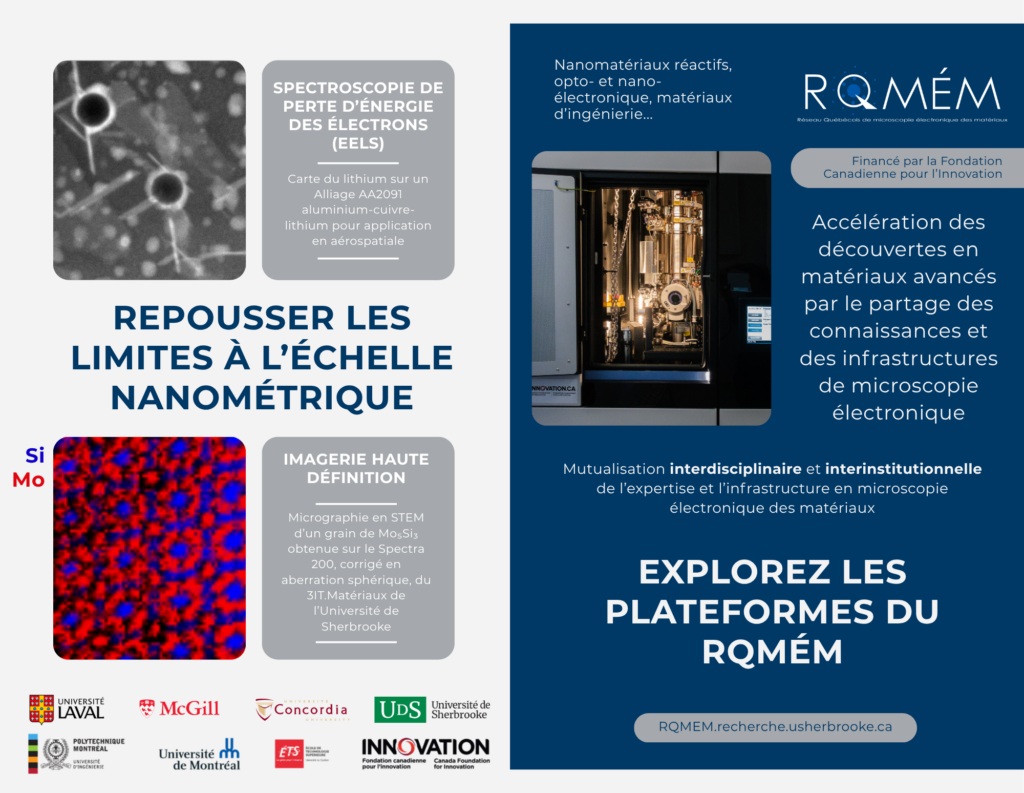
The RQMEM adapts to the technological evolution of scientific needs, aiming to improve continuously on the quality of equipments and services.
Details on offered electron microscopy courses
Techniques d’analyse
Course description :
Introduction to physicochemical analysis methods of materials. Scanning electron microscopy (SEM), transmission electron microscopy (TEM) and atomic force microscopy (AFM). X-Ray diffraction (DRX); crystallography principles. Photoelectron spectroscopy (XPS). Analysis of trace elements (absorption and emission spectrometry : AS, OES). Mass spectrometry (MS). Particle size analysis by laser methods (DLS). Laboratories.
Laval University, 3 credits, all cycles
Link to course website : GML-4103 ; GML-7003 Techniques d’analyse
Microscopie électronique : théorie et pratique
Course description :
Through a combination of lectures and hands-on exercises, participants explore the history of various electron microscopy techniques—ranging from transmission electron microscopy to cryo-electron tomography—learn the theory behind how transmission electron microscopy works, and participate in the preparation and analysis of various samples using a state-of-the-art microscope.
Laval University, 3 credits, PhD
Link to course website : NSC-8002 Microscopie électronique : théorie et pratique
Microstructure et propriétés des matériaux
Course description :
The microstructure of a material can vary significantly depending on the manufacturing processes used, secondary processing operations, the application of the component in service, and so on. This course therefore aims to provide students with a solid foundation for understanding the general behavior of materials, solidification, the parameters influencing the mechanical properties of alloys, the relationship between microstructure and phase diagrams, as well as heat treatments that can modify microstructures. These basic concepts will eventually be reinforced by other courses in the Materials Engineering and Metallurgy program.
Laval University, 3 credits, undergrad
Link to course website : GML-2003 Microstructure et propriété des matériaux
Techniques de caractérisation des matériaux
Course description :
Optical microscopy, sample preparation, and applications. Limitations of use. Interaction of radiation with matter (X-rays and electrons). X-ray diffraction. X-ray fluorescence. Scanning electron microscopy, ESCA, Auger, transmission electron microscopy. Secondary ion mass spectrometry, neutron activation, scanning tunneling microscopy, and environmental microscopy. Characterization of granularity, particle size distribution, and specific surface area.
University of Sherbrooke, 3 credits, Masters
Link to course website : GCH740 Technique de caractérisation des matériaux
Techniques de caractérisation des matériaux II
Course description :
High-resolution electron microscopy, cathodoluminescence, atomic force microscopy, and scanning tunneling microscopy (AFM, STM). Near-field optical microscopy, confocal optical microscopy, and micro-Raman spectroscopy.
University of Sherbrooke, 3 credits, Masters
Link to course website : PHY710 Techniques de caractérisation des matériaux II
Introduction aux matériaux
Course description :
Tensile testing, hardness, fatigue. Property diagrams, stiffness, strength, ductility, toughness, performance index. Bonding, atomic structure, metal, plastic, ceramic. Crystalline and amorphous forms, crystallography, defects, dislocations, solid solutions, binary phase diagrams, alloys, steel, microscopy. Ductile-brittle transition.
Laval University, 2 credits, undergrad
Link to course website : ING301 Introduction aux matériaux
Matériaux fonctionnels
Course description :
This interinstitution course aims to acquire expertise in functional material sciences by integrating the multidiciplinarity that is inherent to this theme.
Interinstituion, 3 credits, masters and PhD
Link to course website : CHM6465 Matériaux fonctionnels
Méthodes en microscopie à haute résolution
Course description :
This course consists of lectures and laboratory sessions designed to familiarize students with cutting-edge techniques in high-resolution microscopy. Several experts are invited to share their expertise with the students.
University of Montreal, 1 credit, masters and PhD
Link to course website : BCM6019 Méthodes en microscopie à haut résolution
Caractérisation des matériaux en génie de la construction et de l’environnement
Course description :
The aim of this course is to show the caracterisation of materials microstructures used in civil engineering and environmental engineering
The topics covered will include the principles of sampling granular materials and surfaces, sample preparation, calibration, and the operation of characterization instruments, particularly for materials used in civil and environmental engineering. These topics will be addressed through methods involving spectroscopy, analysis of inorganic and organic solutions, paste fluidity, thermal analysis, X-ray diffraction, resistivity, nuclear magnetic resonance, microscopy, microbiology, and image analysis.
By the end of this course, the students will be able to develop a caractrerization plan, choose and justity the characerization methods for their materials according to their needs and limitations, analyse and discuss the data coming from the instruments
École de technologie supérieure, 3 credits, masters
Link to course website : MGC922 Caractérisation des matériaux en génie de la construction et de l’environnement
Mise en forme des alliages : expérimentation et simulation
Course description :
This course enables students to deepen their knowledge and understanding of various forming processes used in industry. They will gain knowledge of microstructural changes; the principles of forming tool design; and the simulation of forming processes.
École de technologie supérieure, 3 credits, undergrad
Link to course website : MEC300 Mise en forme des alliages : expérimentation et simulation
Caractérisation des matériaux
Course description :
Analysis of microstructure and composition: optical microscopy, electron diffraction, scanning probe microscopy (tunneling effect, atomic force), electron microscopy (scanning, transmission). Non-destructive spectroscopic methods investigating the interactions of electrons, ions, and photons with solids and surfaces. Destructive methods for quantitative compositional analysis: plasma methods, dissolution methods, and alternatives. Coupled analytical methods (composition, structure). Effect of the environment on the stability and performance of materials.
Polytechnique Montreal, 3 credits, masters and PhD
Link to course website : MTR6040 Caractérisation des matériaux
Caractérisation minéraologique
Course description :
Introduction to the principles and applications of experimental characterization techniques. Electron optics, electron-matter interactions and emitted signals, scanning electron microscopy (SEM), image interpretation, X-ray spectroscopy, acquisition of X-ray spectra, quantification of X-ray analyses. Application of SEM in mineral engineering.
Polytechnique Montreal, 3 credits, masters and PhD
Link to course website : GML6604 Caractérisation minéraologique
Techniques de caractérisation des matériaux I
Course description :
Introduction to the principles and applications of experimental characterization techniques. Topics covered: electron optics, electron-matter interactions and emitted signals, scanning electron microscopy (SEM) and transmission electron microscopy (TEM), X-ray and Auger electron spectroscopy, TEM imaging, image interpretation, definition of diffraction conditions, acquisition of X-ray spectra, quantification of X-rays obtained in TEM.
Polytechnique Montreal, 4 credits, masters and PhD
Link to course website : MET6103A Techniques de caractérisation des matériaux I
Electron Microscopy and 3D Imaging for Biological Materials
Course description :
Introduction to electron microscopy and 3D imaging. Dual-beam microscopy (FIB-SEM, or focused ion beam – scanning electron microscope); conventional and cryogenic preparation methods for biological materials. Complementary methods such as X-ray diffraction, X-ray tomography, atom probe tomography. 3D image processing and analysis, and the fundamentals of deep learning in imaging.
McGill University, 3 crédit
Link to course website : BIEN535 Electron Microscopy and 3D Imaging for Biological Materials
Analytical and Characterization Techniques
Course description :
Bulk, surface and microanalytical techniques for materials characterization. Bulk analysis: spectrophotometry using UV, visible, flame and atomic absorption, x-ray diffraction and x-ray fluorescence. Surface and microanalysis: infrared spectroscopy, scanning and transmission electron microscopy, Auger electron and x-ray photoelectron spectroscopy.
McGill University, 3 crédits
Link to course website : MIME317 Analytical and Characterization Techniques
Principles and Applications of Materials Characterization
Course description :
Fundamentals of materials characterization methods and their applications in materials chemistry. Topics include static and dynamic mechanical testing, vibrational spectroscopy (Raman and FTIR), surface-based spectroscopies (XPS, Auger), advanced electron microscopy methods, X-ray absorption spectroscopy and X-ray diffraction (pXRD, WAXD, SAXS).
McGill University, 3 crédits
Link to course website : CHEM603 Principles and Applications of Materials Characterization
Electron Beam Analysis of Materials
Course description :
Emphasis on operation of scanning and transmission electron microscopes. Topics covered are electron/specimen interactions, hardware description; image contrast description; qualitative and quantitative (ZAF) x-ray analysis; electron diffraction pattern analysis.
McGill University, 3 crédits
Link to course website : MIME569
Structure of Materials
Course description :
Classification of materials, electrons in atoms, molecules and solids, bonding in solids, elements of crystallography, common crystal structures, atoms positions, directions and planes in crystal structures, defects in crystalline solids, point defects, dislocations, structure of polycrystalline materials, grains, grain boundaries, non-crystalline solids.
McGill University, 3 crédits
Link to course website : MIME261 Structure of Materials